

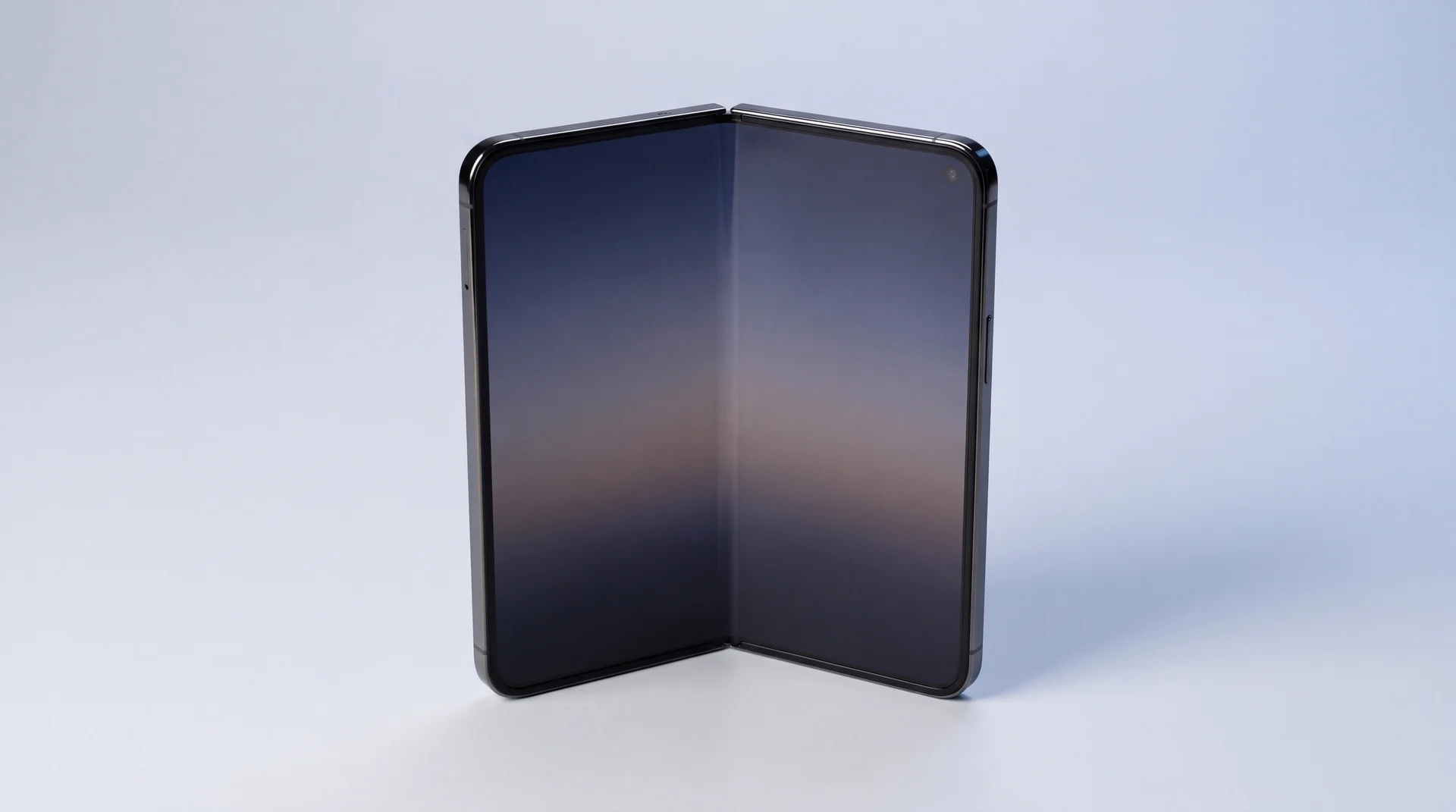
The short answer: for most people, not yet. A folding phone's inner screen is marked by a fingernail, costs £999 to replace on the iPhone Duo, and the warranties exclude most of the ways it fails. Until a folding screen gets a cover as hard as a slab phone's glass, or the manufacturers stand behind it in the warranty, a foldable is not a sensible everyday phone.
The iPhone Duo's first weekend is the evidence. "Crackgate" is the name owners have given to a fault on Apple's first folding phone where the 7.6 inch inner screen fails along the hinge within hours of unboxing, leaving a dark point at the fold and a bright line across one half of the display. Despite the name, a folding screen has no cover glass thick enough to crack: its glass is about 30 micrometres, under a polymer skin. Pressure at the hinge goes straight into the OLED panel, and in our reading of the photos the dark point is a patch of dead panel and the lines are rows of pixels cut off from their drive, which is how the OLED in any iPhone dies when something gets through its glass. This post sets out why, with Apple's and Samsung's own numbers.
Is the iPhone Duo screen cracking?
Not in the way the word suggests. Some inner screens are failing at the hinge within hours with no mark on the surface: the OLED panel underneath is dying, not a cover breaking. Here is what has been reported so far:
- Friday 23 October 2026: the Duo goes on sale in the UK at £1,999. That afternoon The Verge reports the first failed inner screen.
- By Sunday 25 October: 9to5Mac counts about ten unique cases, from Australia, China, the US and Canada.
- What it looks like: a dark point at the hinge, a thin line up or down the crease, and a bright horizontal line or band across one half of the screen. No scratch, no impact mark.
- Apple's response: no statement. Owners who went into an Apple Store were mostly given a new phone on the spot; at least one carrier buyer was told they must have dropped it.
The sources for that timeline are The Verge and 9to5Mac. The photos are strikingly alike, and the three below show the pattern. The surface is unmarked in every one, and the press have been calling it a crack because that is what a broken phone screen usually is. Our reading, from years of OLED work on the bench, is different: a dead black spot is OLED that has stopped emitting, and a bright stripe is a row of pixels stuck on because the hairline conductor that drives it has been severed. That is the panel failing, not a cover breaking.
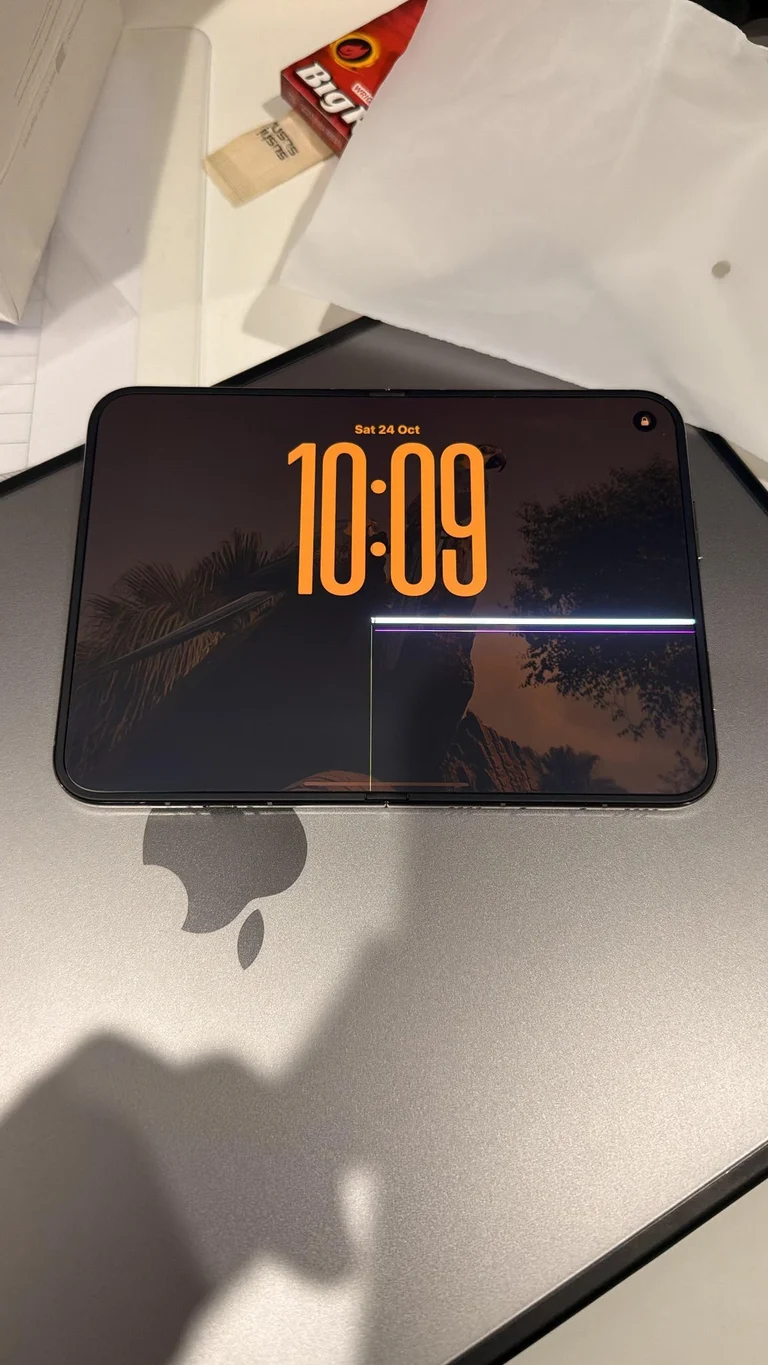
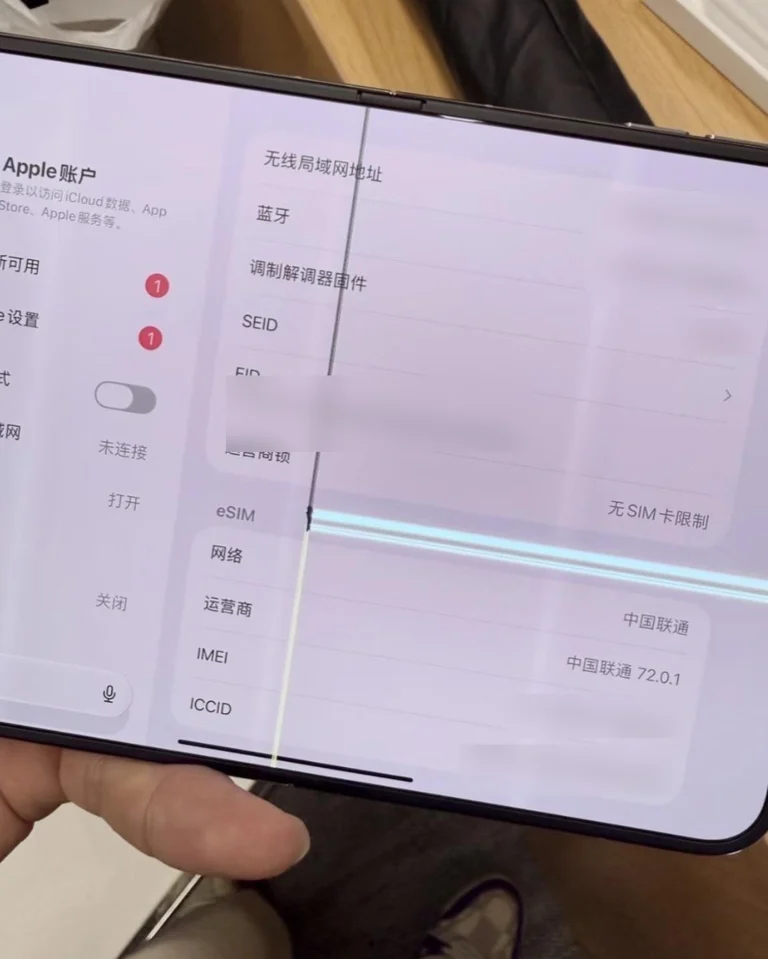
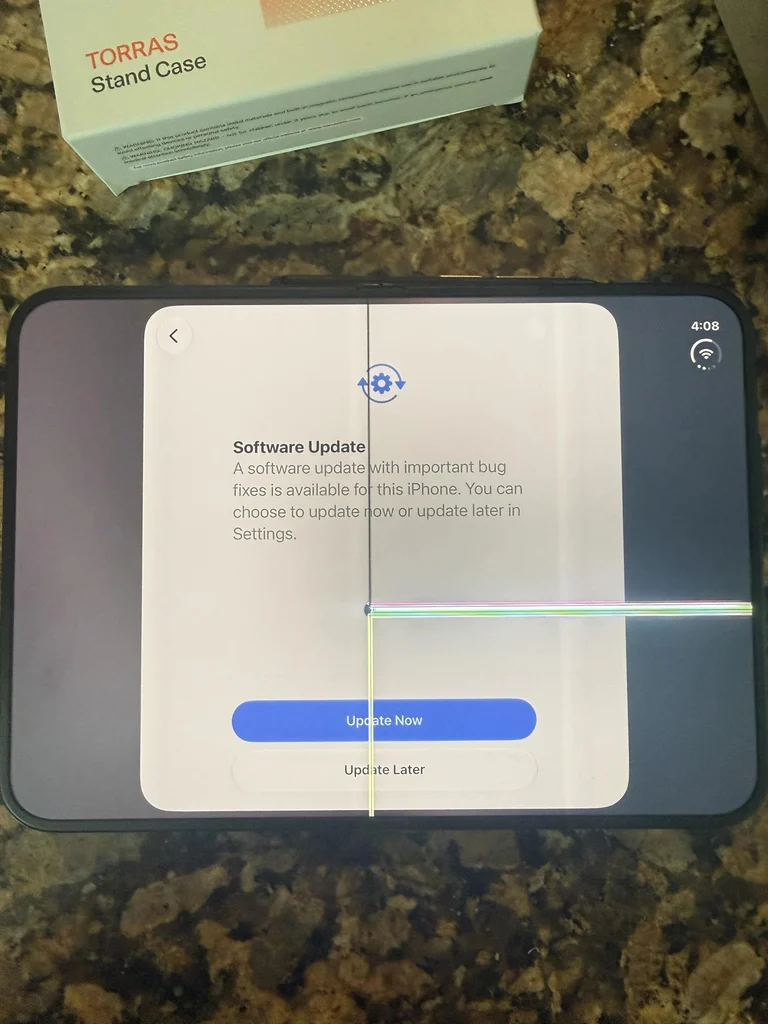
The owner whose post started it, in Australia, had the phone about six hours and had opened it fewer than twenty times. In their words, quoted by MacRumors: "I felt something around the internal hinge, underneath the screen... I heard an audible crack, and the screen broke right along the hinge. There were no marks or damage on the inner screen's surface or the external hinge to suggest anything had been caught." A second owner in Dallas said the hinge went tight after about four folds, they pushed through it, and heard a loud pop. The working theory, as 9to5Mac puts it, is a batch with a hinge component slightly out of line that pokes up into the panel. No teardown has confirmed that yet, and Apple has not commented.
Most owners who went to an Apple Store were handed a new phone on the spot. The ones who bought through a carrier have had a rougher time: the same report has one being told they must have dropped it and that the repair was on them.
Owner photos above were shared publicly in the first days after launch.
If that is your phone, do these five things now
Stop folding it
Every close presses on the damaged area. Leave it open on a desk if you can. If the line already crosses the whole screen, leave it closed and use the outer screen.
Photograph it, screen on and screen off
The dark point and the line are evidence that nothing hit the surface. A photo with the screen off shows the untouched cover layer; one with it on shows the dead pixels.
Do not peel the cover layer
Apple calls it "an integral part of the inner display" and says not to remove it. Peeling it hands the seller a reason to refuse.
Back it up if it still runs
A replacement means a different phone. The outer screen usually still works, so a backup over Wi-Fi is normally possible.
Go to the seller, in the first 30 days if you can
Apple Store if you bought from Apple; the network if you bought on contract. Ask for a refund or replacement under the Consumer Rights Act, not the warranty. The rights section below has the wording.
Not sure whether it is a warranty job or a repair? The diagnostic on a folding phone at mendmyi is free, and if the seller should be paying we will say so.
Why does a folding screen fail from the inside?
Start with what an OLED screen is, because it explains everything in the photos. The panel in an iPhone 12, an iPhone 17 Pro or a Galaxy S25 is a thin film of organic pixels on a flexible plastic backing. Take the glass off a slab iPhone's screen on the bench and the panel underneath will bend. It is the same technology as the one in a folding phone; the folding phone just leaves the glass off. On a normal phone that glass does two jobs. It takes the hit, and it spreads it. When a key or a kerb gets through it, the glass cracks and the OLED behind the impact dies in a dark patch and throws lines across the screen, which is the "cracked screen with lines" every repair shop sees daily. A foldable has nothing hard enough in front of the panel, so a point of pressure that a slab phone's glass would shrug off goes straight through to the OLED. The result is the same dead patch and the same lines, with no visible crack, because the only glass there is too thin to show one.
That is what the Duo's inner screen is made of. Apple's own launch announcement describes the Duo's inner screen as "a nano-textured cover layer, made from a custom polymer" on top, "high-strength glass above and below the folding display panel" underneath, and "a titanium plate at the bottom". That is the same recipe every foldable uses. Samsung UK describes the Galaxy Z stack as "protective film, a protective layer and Ultra Thin Glass", and Samsung Display puts that folding glass at about 30 micrometres against 500 for the cover glass on a normal phone. A plastic skin over glass one sixteenth the usual thickness, with an OLED panel under it that is itself a film.
That stack bends beautifully and resists almost nothing pressed into it. JerryRigEverything's durability test marked the Duo's inner screen at level 2 on the Mohs scale, a fingernail, while the outer Ceramic Shield screen held to level 7. Which? found the same across 59 foldables: every one survived 100 drops, all but one very early model survived 30,000 machine folds, and their screens averaged 1.3 out of 5 for scratch resistance against 5 for glass, "permanently marked by something as simple as a firm fingernail". Apple's own handling guide for the Duo spells it out: keep "sand and grit away from the hinge", make sure the hinge is clean before you open it, and never close "hard objects such as keys or coins" inside, because they "can damage the inner display".
Now picture what a folding phone does a hundred times a day. It closes on itself, pressing the two halves of that soft screen together with whatever is between them. Ars Technica's reviewer lost a Pixel Fold in four days this way: "The tiniest bit of something got in there, and when I closed the display, the pressure of the other display side was enough to puncture the OLED panel." A punctured OLED does not look like a scratch or a crack. It looks like a dark spot, then a line, exactly as in the photos above. Samsung UK's own support page warns that an impact on the ultra thin glass "is likely to crack or break, which can spread to the surrounding areas resulting in the appearance of a white line while folding the device".
A folding phone has no cover glass thick enough to take a hit. The glass that would have taken it has been thinned to 30 micrometres so it can bend, so the screen itself takes it, and a hinge is a machine that presses that screen against itself every time you close it.
We see the same failure on the Fold and the Flip
Samsung Galaxy Z Folds and Z Flips have been coming across the bench at mendmyi for years, and the Duo photos could be any of them. The pattern we see on a Samsung Galaxy Z Fold 7 or a Z Flip runs like this. A black line or a cluster of black dots forms along the hinge, through nothing more than normal folding, with no drop and no mark on the surface: the panel dying along the line where it is bent and pressed every day. Or the plastic top layer creases along the fold, then bubbles, lifts, deforms and finally splits, and once it has gone the thin glass and the OLED under it are on their own. Samsung's page calls that film "a consumable product" on which "scratches, bubbles, and lifting may occur due to normal wear", and that is Samsung's own description of the part that sits on top of a £594 screen.
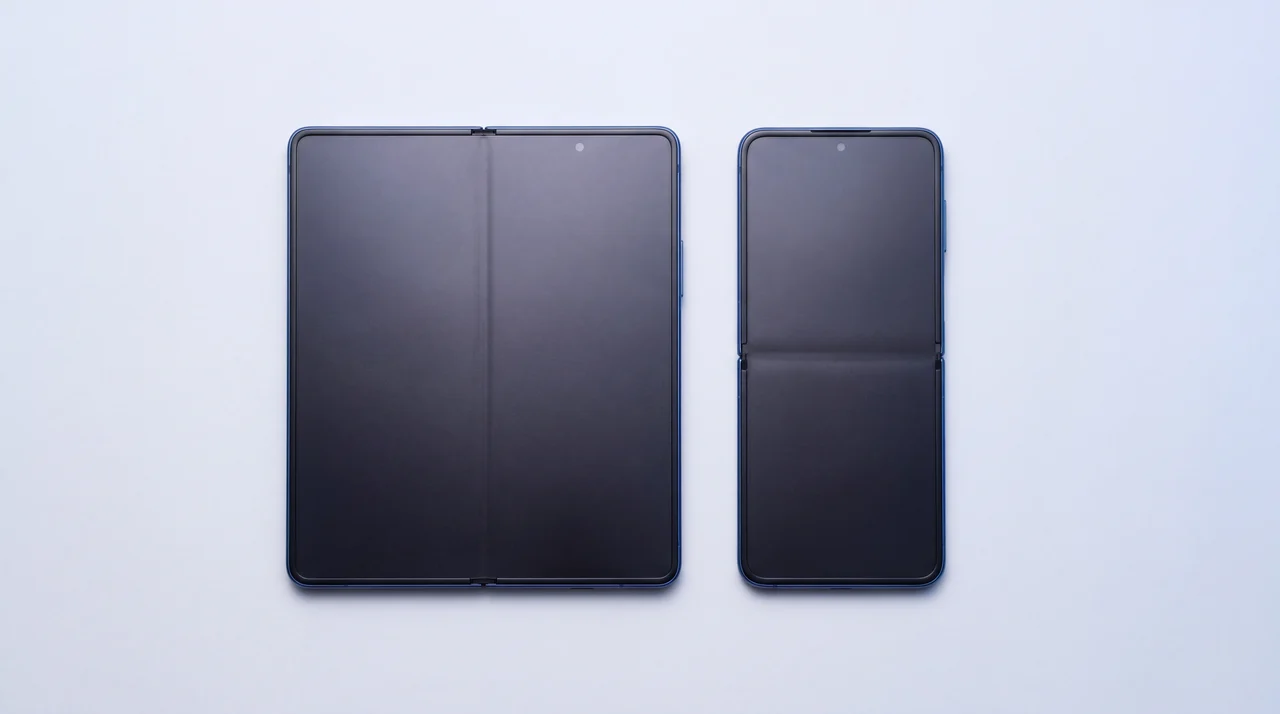
The owners' stories match ours. Galaxy Z Fold 3 owners reported "cracks, lines, and dead pixels appearing in the folding screen for no obvious reason", and TechSpot quotes one who was told by Samsung there was "an impact point" he denied making, and billed 700 dollars. iFixit's dust test on the Z Fold8 in August 2026 left the hinge "caked" in 0.04 mm powder and crunching. Every major foldable line has documented inner-screen failures at or near the fold. The Duo did not break the pattern. It joined it on day one.
What is unusual is the speed. A Fold that develops a black line at the hinge has usually been folded for months. The two best-documented Duos had been opened fewer than twenty times and about four times respectively, which is why the hinge-component theory is the one worth watching: it would mean the point load that normally takes a year of lint to build was built into some units at the factory.
Are folding phones durable?
Everywhere except the inner screen, yes. On drops and fold cycles, current foldables pass the same lab tests a normal phone does. The folding screen does not, and it is the part that costs the most.
Where they hold up
- Drops: all 59 foldables Which? has tested since 2020 survived 100 drops from 80 cm.
- Hinges: 58 of those 59 survived 30,000 machine folds; Samsung Display rates the Z Fold7 panel at 500,000 folds, verified by Bureau Veritas. Apple publishes no figure for the Duo.
- Outer screen: the Duo's Ceramic Shield outer display marked at Mohs level 7, the same as a slab iPhone.
- Water: the Duo is rated IP68. That covers water, not grit.
Where they fail
- The inner screen: Mohs level 2 on the Duo, a fingernail; Which? scores foldable screens 1.3 out of 5 against 5 for glass.
- Point pressure at the fold: grit in the hinge, a coin closed inside, or a hinge part out of line, and the OLED dies in a spot and a line.
- The cover film: Samsung calls it a consumable that scratches, bubbles and lifts with normal wear.
- The bill: £999 for a Duo inner screen, £594 for a Fold8, £329 for a Flip8, and warranties that exclude scratches, dents and external causes.
Why titanium is an odd choice for a phone that folds
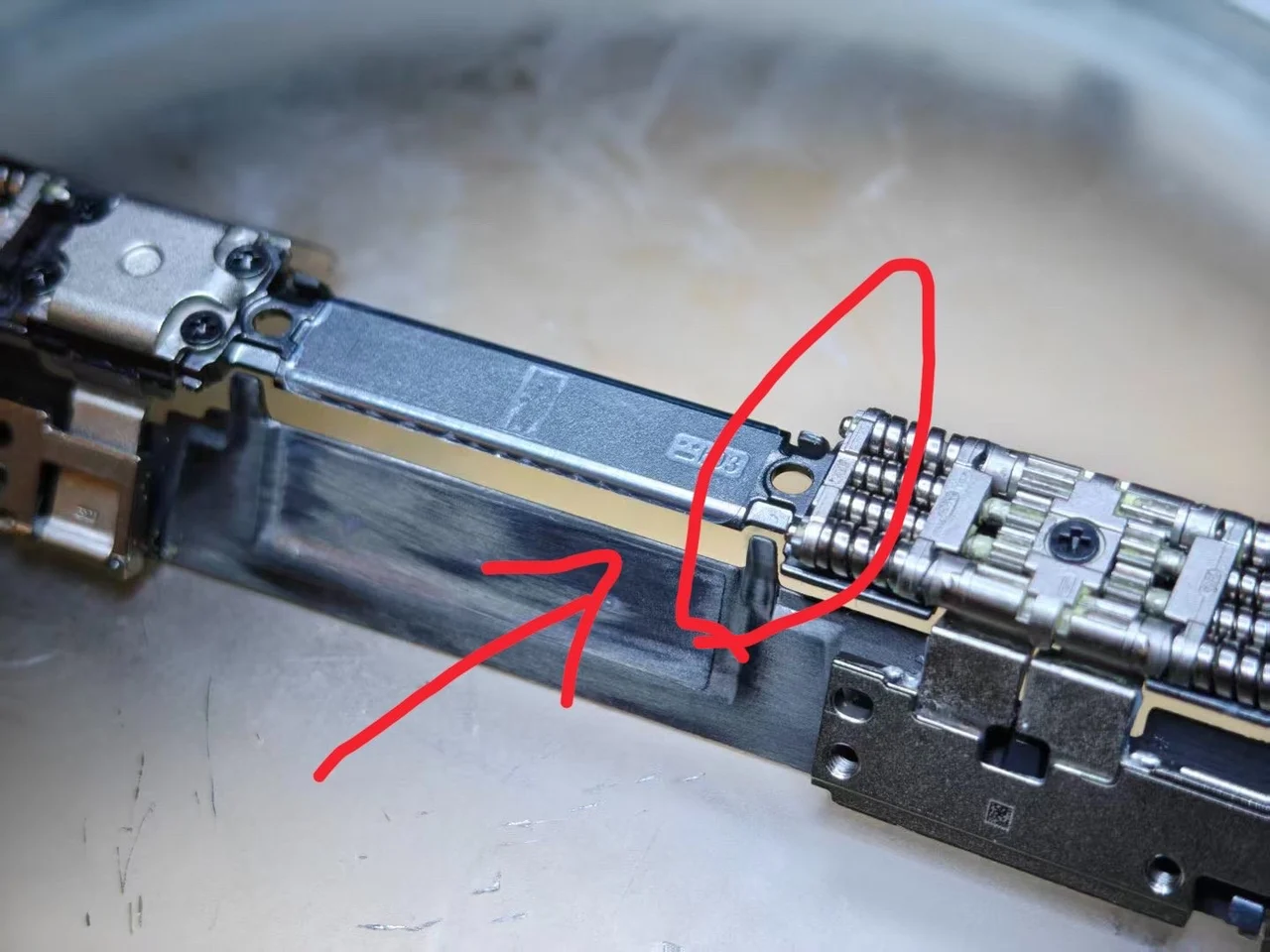
Apple makes the Duo's frame and hinge cover from grade 5 titanium, and in the launch copy that reads as a strength story. It is one. Grade 5 titanium has an elastic limit of around 786 to 910 MPa and a stiffness of 110 to 119 GPa (AZoM), against a yield of 276 MPa and 69 GPa for the 6061 aluminium used in most phone bodies (AZoM). Roughly three times the strength and getting on for twice the stiffness. A frame that strong does not give. Our concern, as the people who will be asked to fix these, is what that means for a hinge that Apple says is "engineered from more than 100 components" moving inside it. When a moving part in a mechanism that stiff ends up a fraction out of tolerance, something has to yield, and in this design the softest thing in the stack is the screen. That is our inference from the materials, not something Apple has said.
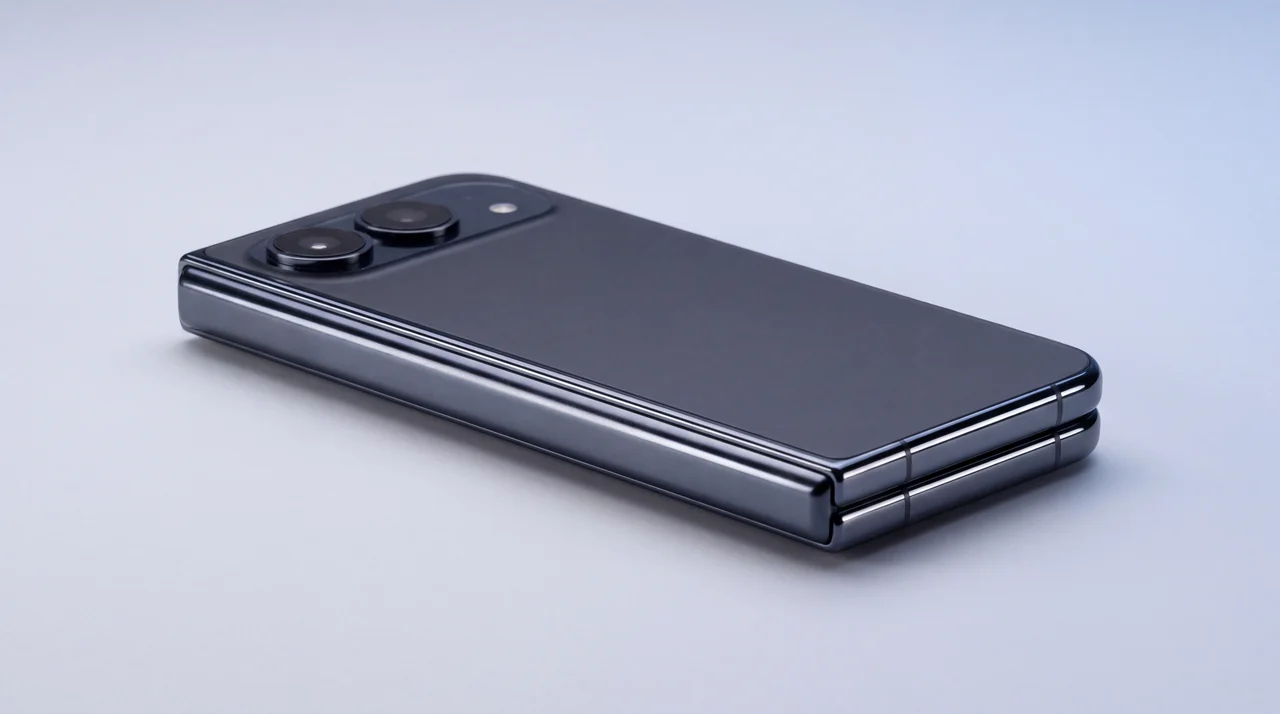
The second oddity is heat. Grade 5 titanium conducts heat at about 7 W/m·K; 6061 aluminium manages around 167. That is roughly 25 times worse at moving heat out of the body, and Apple knows it: the Duo gets "a custom-designed vapor chamber" bonded to the A20 Pro, and AppleInsider reports a flexible graphite pipe through the hinge to join the two halves, with Apple's thermal lead calling the hinge "one of the most technically challenging aspects of our design". When the iPhone 15 Pro ran hot in 2023 Apple said its titanium frame was not the cause and fixed it in iOS 17.0.3. What we would point out is simpler. The inner screen is glued into that frame, and Apple's own repair procedure removes it with a "heated display removal fixture" and a "heated inner display pocket", because heat is what softens the adhesive. A frame that holds its warmth, a glued-in panel whose adhesive is designed to let go when warm, and a phone that closes on itself: we will be watching for lifted edges on the Duos that come in, because any gap at the edge of a folding screen is an open door for lint. That last part is our opinion from the bench, not something Apple or anyone else has confirmed.
What the repair involves, in Apple's own manual
Apple published the iPhone Duo repair manual on launch day. There are two ways to fix the inner screen. The "Inner Display" procedure replaces the bare panel: ten dedicated tools including a display press and a heated removal fixture, the old panel cut out around its edge and stopped "at the hinge", 21 glue pockets cleaned by hand, new adhesive laid, glue injected by syringe, then "let the inner display set for 1 hour" before it goes into the press. The caution in the middle reads: "Inserting the tool too deep can damage the flex cables and the hinge." The "Inner Display Assembly" procedure is the other route, and it is a whole new body with the hinge and screen already fitted, into which the logic board, both batteries, the cameras and the outer screen are transplanted from the old one. Apple's hinge troubleshooting page says a hinge fault gets that second route: "replace the inner display assembly".
Two things in that manual matter to a repairer. The bare-panel procedure has no debris step. The cover-layer procedure in the same manual blows the panel down with compressed air before the new layer goes on; the inner display procedure only says to clean the glue pockets and residual adhesive. On a screen that a grain of sand can kill, that is the gap we would worry about most: a panel glued back into an enclosure that was not perfectly clean, or an edge that did not seal, is a screen waiting to develop the same dark spot again. That is our judgement rather than anything in the manual. And the panel is not where the hinge fault lives, so if the Crackgate theory is right, a bare-panel repair on an affected unit puts a new screen against the same misaligned part. iFixit said before launch it probably would not be fixable; the first independent teardowns took a full hour to pry the inner panel out and could not refit its frame. None of that puts the repair out of reach. It raises the bar of skill, and we clear it: we refurbish OLED panels in house and have done for years, so a bare folding panel on a press is work we know. What makes us wary is the design, not the difficulty. We put 12 months of warranty on what leaves the bench, and it is hard to stand behind a repair when the part you have just fitted is the same soft panel against the same hinge that killed the last one.
If you want a sense of how a normal screen repair compares, our guide to iPhone screen quality is the one to read: a glass slab screen is a part we fit in under an hour with a known-good result.
What it costs, and what the warranty actually covers
These are the manufacturers' own UK out-of-warranty prices for the inner screen, taken from Apple's repair estimator and Samsung UK's repair cost page on 25 October 2026. Google publishes no UK price for the Pixel Fold's inner screen.
| Phone | Inner screen, out of warranty | Care plan and excess |
|---|---|---|
| iPhone Duo | £999 (cover layer alone £49; "other damage" £1,499) | AppleCare+ with Theft and Loss £16.99 a month or £169.99 a year; £79 excess on the inner screen |
| Galaxy Z Fold8 | £594 (Fold7 £569) | Samsung Care+ excludes a "scratched screen or dented casing"; premium and excess shown only at purchase |
| Galaxy Z Flip8 | £329 (Flip7 £304) | As above |
| iPhone 18 Pro Max, for comparison | £389 | £25 to £79 screen excess with AppleCare+ |
So the Duo's inner screen costs about two and a half times a Pro Max screen, half the price of the phone, and the care plan that brings it down to £79 costs £169.99 a year on top of the £1,999. Now read what the warranties say about the ways a folding screen actually fails. Apple's UK one-year warranty does not apply to "protective coatings that are designed to diminish over time", to "cosmetic damage, including but not limited to scratches, dents", to damage from "accident, abuse, misuse... or other external cause", to use "outside the user manual... or other Apple Product published guidelines", or to "normal wear and tear". Google's excludes "exposure to sharp objects" and "exposure to excessive force". Samsung's US support page says removing the pre-applied protector voids coverage of the damage it causes. Put the handling guide and the warranty side by side and the shape is clear: the manufacturer tells you the screen is damaged by grit, coins and fingernails, then excludes damage from external causes and from ignoring its guidance.
If a tyre company sold a tyre that its own leaflet said would be punctured by gravel, and then declined claims for punctures, nobody would call that a durable tyre. Folding phones are an expensive research project, and the warranty terms make sure it is the customer who funds it.
We would say that about a Fold, a Flip or a Pixel Fold just as readily as about the Duo, and we have been saying it to customers across the counter for years.
On the first weekend, the early Duo owners who went into a store mostly got new phones, and Apple has issued no statement blaming owners. Whether that holds for a line that appears in month eight, when there is no news story attached, is unknown, and Samsung's track record with the Fold 3 is the best guide we have.
Your rights in the UK if your folding screen fails
The warranty is a voluntary extra. Your real protection is the Consumer Rights Act 2015, and on a brand-new phone it is stronger than the warranty. As Which? sets it out, within 30 days of purchase you can reject goods that are not of satisfactory quality and get a full refund. Between 30 days and six months you must give the retailer one chance to repair or replace, and a fault that shows up in those first six months "is presumed to have been there since the time you took ownership of it, unless the retailer can prove otherwise". After six months that burden flips to you. Apple's own UK statutory rights document says the same, and the Duo order page adds that AppleCare "benefits are separate from a consumer's right to a free of charge repair or replacement, by the seller". Apple also gives a 14-day change-of-mind return on top.
The word to notice is seller. Those rights are against whoever took your money, so a Duo bought on a network contract is the network's problem, not Apple's, and that is the route where owners have already been told they must have dropped it. If that happens to you, the six-month presumption is the sentence to quote back, in writing.
The five steps under the owner photos above are the practical version of this.
Should you buy a folding phone, or keep the one you have?
For most people, not yet. A foldable makes sense if you work on the big screen every day, you will carry it the way you would carry a tablet rather than drop it in a jeans pocket with your keys, and you buy the care plan on day one so a failure costs £79 instead of £999. Everyone else is better served by a slab phone with a glass screen, and will be until one of two things changes: a folding screen gets a cover as hard as glass, or a manufacturer puts the inner screen inside the warranty rather than outside it. Apple has gone further than anyone on the first half, with glass above and below the panel and a plate under it, and the first weekend's photos show how far there still is to go.
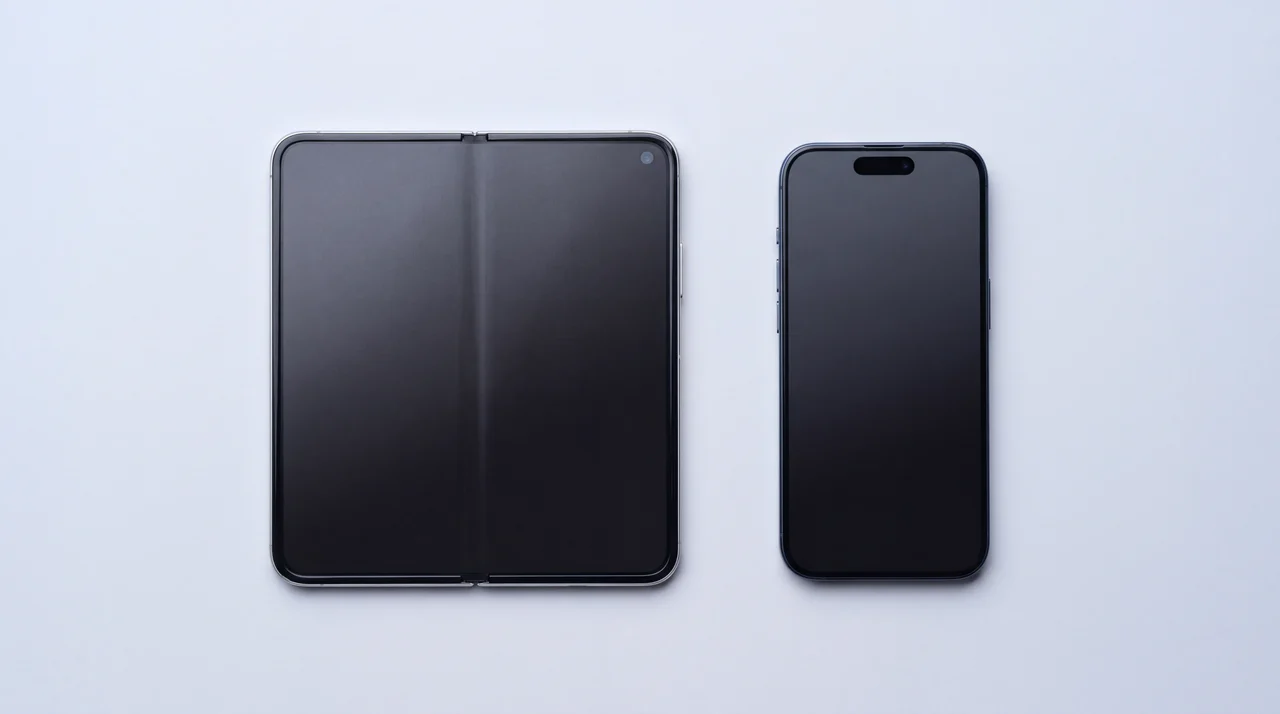
If you already own one, the practical advice is the manufacturer's own, which we would simply take more seriously than the marketing: clean pockets, nothing closed inside it, opened on a desk rather than one-handed on a bus, and the pre-fitted cover layer left alone. The IP68 rating covers water, not grit, and water resistant is not waterproof on a hinge with a hundred moving parts either.
A line or a spot on your folding screen?
Bring it in. The diagnostic on the iPhone Duo is free, as it is on every Fold, Flip and Pixel Fold. We check the hinge and the frame before we quote a screen replacement, because a new panel against a bad hinge is money wasted, and if the phone is inside its first six months we will tell you to take it back to the seller first. A written quote before any work, 12 months of warranty on what we do.
Had enough of folding?
We buy them. Sell your iPhone Duo, or a Fold or Flip, for a price agreed up front, or trade it against a refurbished phone with a glass screen and let us move your data across. Our guide to wiping a phone before selling covers the steps. If it is a cracked slab iPhone you are weighing up instead, repair or replace works through that with live prices.
Folding phone screen enquiry
Tell us the phone, when you bought it and what the screen is doing, and we'll come back within 24 hours with the next step.
The bottom line
The iPhone Duo failures are the folding-screen problem with an Apple logo on it, and they are not cracks. The OLED is the same film that sits under the glass of every iPhone, with the glass thinned until it bends, and it dies from point pressure at the fold: a grain of sand, a coin, months of lint, or, if the early theory holds, a hinge part a fraction out of line from the factory. The repair is a ten-tool glue-and-press job or a body transplant, the bill is £999, and the warranty excludes most of the ways it happens. Inside six months the Consumer Rights Act is on your side, against the seller. Beyond that, you are paying for the research, and it is the same deal on every folding phone we have had on the bench.
Folding phone screens: your questions answered
Do foldable phones break easily?
Not from drops, and not from folding: Which? drops every foldable it tests 100 times from 80 cm and folds it 30,000 times by machine. All 59 models tested since 2020 passed the drop test and 58 of them passed the fold test, the one failure being a very early model. The weak point is the inner screen. The surface you touch is a polymer, because glass that thin will not survive bending on its own, and Which? scores foldable screens 1.3 out of 5 for scratch resistance against 5 for a normal glass phone. So they do not break easily in the way a dropped slab phone does. They fail from small, concentrated pressure at the fold: grit in the hinge, a coin closed inside, or a hinge part a fraction out of place. That is a different kind of fragile, and it is the kind that does not look like damage from the outside.
What is the biggest problem with foldable phones?
The inner screen, and what it costs when it goes. The rest of a modern foldable tests close to a normal phone: Samsung rates the Z Fold7 panel at 500,000 folds and Which? has run 59 models to 30,000 with one early failure, the outer screen is proper glass and the body is water resistant. The folding panel is still a soft layer over glass about 30 micrometres thick, and the manufacturers price it accordingly: £999 for an iPhone Duo inner screen out of warranty, £594 for a Galaxy Z Fold8, £329 for a Z Flip8. The second problem follows from the first. The warranties exclude scratches, dents, external causes and use outside the published handling guidance, which is exactly the category most inner-screen failures land in, so the bill tends to land on the owner.
What is the lifespan of a foldable phone?
On the hinge, long: Samsung Display rates the Z Fold7 panel at 500,000 folds, verified by Bureau Veritas, which is around 270 a day for five years. Apple publishes no fold rating for the iPhone Duo at all. In practice the life of a foldable is decided by the inner screen rather than the hinge, and that depends on how it is used. A phone that lives in a clean pocket, is never closed on anything and is opened on a desk can last years. One that lives in a bag with keys and sand is a candidate for a line or a dark spot long before the hinge is anywhere near its rating. On the bench the Folds and Flips we see with screen faults are usually well inside their hinge life.
Will Apple fix a cracked iPhone Duo screen under warranty?
So far, yes, for the early hinge failures, which are not cracks at all but the OLED panel dying where something has pressed into it from the hinge side. Owners reporting the day-one failures have mostly walked into an Apple Store and been given a replacement on the spot, and Apple has not published any statement blaming owners. The warranty wording is less generous than that experience. Apple's UK one-year limited warranty excludes cosmetic damage including scratches and dents, damage from accident or any other external cause, and use outside Apple's published guidelines. Apple's handling guide for the Duo tells you to keep sand and grit away from the hinge and never close keys or coins inside, so a dead patch Apple decides was caused by debris can fall outside the warranty. If you bought from a network rather than Apple, your Consumer Rights Act claim is against the network, and one carrier buyer has already reported being told they must have dropped it.
How much does it cost to fix an iPhone Duo screen in the UK?
Apple's own UK out-of-warranty price for inner display damage is £999, with a separate £49 service to replace the polymer cover layer and a £1,499 tier for other damage. With AppleCare+, which for the Duo is £16.99 a month or £169.99 a year including theft and loss cover, the inner display excess is £79. For comparison an iPhone 18 Pro Max screen is £389 out of warranty, so the Duo's inner screen costs about two and a half times as much. We do not list a fixed price for a folding inner screen because every one needs the hinge and frame checked before anyone can say what the repair involves, so the diagnostic is free and you get a written quote before any work starts.
Is a Galaxy Z Fold worth buying instead of the iPhone Duo?
The same trade-off at a lower repair bill. A Galaxy Z Fold8 inner screen is £594 from Samsung against £999 for a Duo, Samsung publishes a 500,000-fold rating where Apple publishes none, and Samsung has been building book-style foldables since 2019, so the hinge is a known quantity. The screen is not a different technology, though. It is the same soft panel over ultra thin glass under a consumable film, Samsung UK warns that an impact on it produces a white line, and the Folds and Flips we see on the bench fail at the fold in exactly the way the Duo photos show. If you want a foldable, the Fold is the cheaper one to own when it goes wrong. It is not the one that does not go wrong.
Are foldable phones worth it in 2026?
For most people, not yet. The screen you pay the premium for is the one part that has not caught up: a plastic top layer over glass thinner than a hair, priced at £999 to replace on the Duo and protected by a warranty that excludes most of the ways it fails. They are worth it if you use the big screen for work every day, you will carry it like a tablet rather than a phone, and you buy the care plan on day one so the excess is £79 rather than £999. If you want a phone that lives in a jeans pocket with your keys, a slab phone with a glass screen is still the sensible buy, and it will be until a folding screen gets a cover as hard as glass or the makers stand behind the screen in the warranty.
A line on your folding screen? Let us look before you pay anyone
Free diagnostic on any folding phone, a written quote before anything chargeable happens, and we will tell you if the seller should be paying instead.